
Facebook business page fundamentals
Facebook still has a role in B2B — especially for employer branding and local visibility. This chapter walks you through setting up a business page that works.
Social Media Fundamentals

5 min read

It's a fair question. LinkedIn gets most of the attention in B2B circles, and for good reason. But Facebook still has a role to play, particularly for employer branding, community building, and staying visible to audiences who aren't on LinkedIn daily.
Facebook's casual tone lets you show the human side of your business. Behind-the-scenes photos from a team outing, a congratulations post for a colleague's work anniversary, or a short video from an industry event: this kind of content builds trust and relatability in ways that a polished LinkedIn post sometimes can't.
For local service firms across Belgium and the Netherlands such as accountants, law firms, IT consultancies and recruitment agencies, Facebook is also where many clients and candidates still spend time. A well-maintained page signals that your business is active and approachable.
If you haven't created a Facebook business page yet, click the dropdown menu at the top right of Facebook and select Create Page. Once it's live, make sure you have admin access so you can manage content and settings.
Here are the elements that make a Facebook business page work.
Your About section is the first thing visitors read. Think of it as your elevator pitch: who you are, what you do, and who you help. Keep it concise and clear.
Facebook lets you select multiple business categories, which improves your searchability on the platform. A software consultancy might choose both "Software Company" and "IT Services." Pick categories that reflect how your audience would search for a business like yours.
Include a short description that focuses on outcomes, not just services. "We help Belgian SMBs modernise their IT infrastructure" works better than "IT consulting firm established in 2015."
Your profile photo appears next to every post and comment. Use your company logo, sized at 170x170 pixels to fit the circular frame. Keep it simple and recognisable. It needs to work at thumbnail size.
Use the same image across all your social platforms. Consistency builds recognition. If your logo has a bright, distinctive colour, even better: it'll stand out in a crowded feed.
Your cover photo is the largest visual on your page and the first thing visitors notice. The recommended size is 820x462 pixels. Keep key text and imagery centred, since the edges get cropped on mobile devices.
Use it to communicate something current: a campaign, a hiring push, your company values, or a recent milestone. Change it seasonally or for major launches to keep your page looking active.
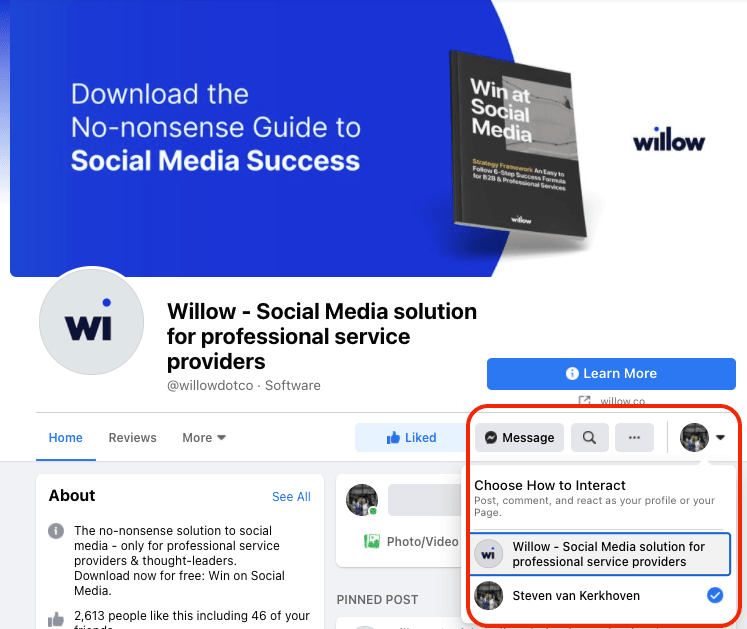
Your username forms part of your Facebook URL: facebook.com/yourusername. Keep it simple and consistent with your other social platforms. If your preferred name is taken, avoid adding numbers or symbols that confuse people. Instead, find a variation that stays on-brand; the way Willow uses @willowdotco everywhere.
A clean, memorable username also looks better when you share it on business cards, email signatures, or printed materials.
The CTA button sits directly below your cover photo. It's one of the most underused features on Facebook business pages, but it's a simple way to guide visitors toward a specific action: visiting your website, booking a meeting, sending a message, or signing up for something.
Choose the CTA that matches your current priority. A consultancy might use "Book Now" to drive demo bookings. A recruitment firm could use "Contact Us" to encourage candidate enquiries. Match the button to what matters most right now, and update it when your focus shifts.
Tabs organise your page content into sections: posts, events, reviews, services, and more. Facebook lets you reorder them so the most important ones appear first.
If you have a services page, event calendar, or review section, move those tabs near the top of the left column. Facebook also offers templates tailored to different business types, which you can find under Settings → Templates and Tabs. These give you a sensible starting layout without having to configure everything from scratch.
You don't need to share your personal login to let team members manage the page. Go to Settings → Page Roles to assign access levels: Admin for full control, Moderator for comment management, or Editor for content publishing.
This keeps your page secure while giving your team the access they need. For most firms, having two admins and one or two editors covers day-to-day management without unnecessary risk.
With these fundamentals in place, your Facebook page is ready for content. Start sharing: team moments, useful tips for your audience, client milestones, and behind-the-scenes glimpses of how your business works. The firms that do well on Facebook are the ones that show up as real people, not just as a logo posting corporate updates.


